

A box of pens may seem like a small expense. Across departments and locations, however, everyday purchasing decisions can create extra costs: different prices for similar products, time spent comparing options, and supplies that sit unused.
The return depends on what your organization buys today and how much effort the new process removes.
Start With the Supplies People Use Most
Focus on repeat purchases such as copy paper, pens, folders, paper towels, and breakroom essentials.
Review which items serve the same purpose, then choose options that meet the needs of the people using them.
Compare pack sizes and cost per usable unit, so a lower package price does not hide a higher ongoing cost.
Frequently Purchased Supplies
Review copy paper, writing instruments, folders, paper towels, and other items ordered regularly across departments.
Cost per Usable Unit
Compare products based on how much usable value they provide, rather than relying only on the package price.
Where Standardization Can Deliver a Return
A consistent workplace supply program can improve purchasing efficiency in several ways. The actual financial benefit depends on product pricing, demand, supplier terms, and how employees use the approved items.
Lower Purchasing Costs
When departments buy comparable products from an approved list, it becomes easier to identify price differences and discuss combined purchasing volume with a supplier.
Savings are possible, but they depend on pricing, demand, and available terms. Buying more than you can use can erase the benefits.
Less Time Spent Ordering
A short, familiar list reduces repeated product searches and questions about which item to choose.
Clear approval rules can also reduce back-and-forth while preserving a straightforward process for justified exceptions.
Fewer Unused Supplies
Shared product choices and visible stock levels make it easier to use what is already on hand before placing another order.
A location with extra folders may be able to transfer them to another office, provided the transfer costs less than buying replacements.
More Predictable Replenishment
Fewer product variations can make usage easier to monitor.
Set reorder points around actual consumption and supplier lead times. Keep a suitable backup option for important items when the preferred product is unavailable.
Keep Room for Different Needs
An approved list should support the work being done. A reception desk and a shipping station may need different paper, labels, or writing tools.
Accessibility needs and equipment compatibility also matter.
Standardize common requirements, not every individual need.
Document exceptions that have a practical reason and make sure employees have a clear process for requesting suitable alternatives.
Test Products Before Making a Broad Change
Test proposed products with the employees who use them before making a broad change.
Writing Instruments
A cheaper pen that employees replace twice as often may cost more per month.
Paper Products
A paper towel that requires more sheets per use may offer little value despite a lower case price.
Evaluate performance, consumption, and compatibility before selecting the preferred product.
Measure More Than the Invoice Total
Compare a representative period before and after the change, allowing for shifts in headcount, occupancy, prices, and workload.
Track supply spending per employee or location alongside order frequency, ordering time, unused stock, and emergency freight charges.
Key Metrics to Monitor
These measures help explain whether a change came from better purchasing or simply lower demand.
Separate cash savings from recovered staff capacity.
Spending less on products or freight can reduce expenses directly. Recovering an hour of employee time creates capacity for other work; it does not automatically reduce payroll.
Avoid counting the same benefit twice.
A Simple Example of the Potential ROI
Consider a hypothetical workplace spending $24,000 a year on supplies.
Assume an approved list reduces comparable product costs by 10%, saves four staff hours a month valued at $25 per hour, and avoids $600 in annual waste and rush freight.
These figures are illustrative assumptions, not Office Solutions results or guaranteed savings.
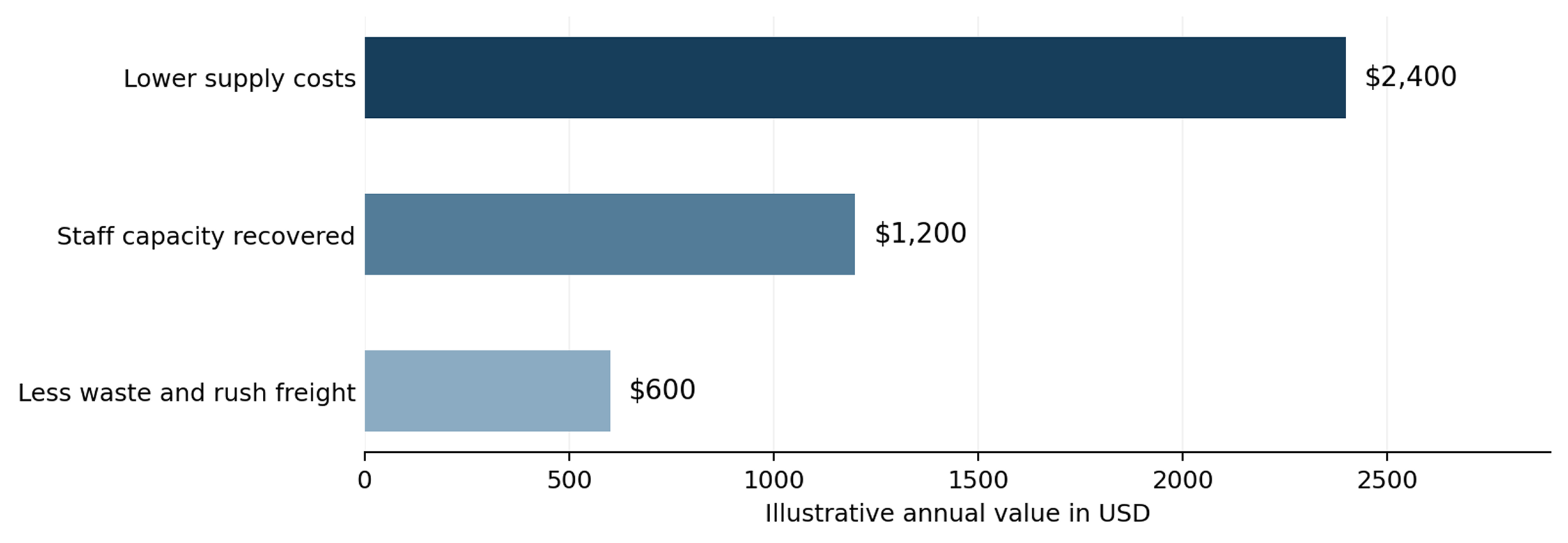
Estimated Annual Benefits
The total estimated annual benefit is $4,200. If the first year requires $1,000 in setup and administration, including internal staff time, the net benefit is $3,200.
First-Year ROI Calculation
Using the illustrative assumptions:
320% Combined ROI
This calculation includes both estimated financial savings and the assigned value of recovered employee time.
Combined Financial and Productivity ROI
320% when the $1,200 value of recovered staff capacity is included in the estimated annual benefit.
Cash-Focused ROI
200% when the $1,200 value of recovered staff capacity is excluded, assuming the remaining benefits and implementation costs are cash expenses.
Use your organization's actual costs.
The example is hypothetical. Calculate ROI using your own spending, supplier pricing, implementation costs, and operational data.
Keep the basis of each calculation consistent and avoid treating recovered staff time as an automatic payroll reduction.
Build an Approved List You Can Maintain
Start with one department or a small group of frequently ordered items.
Review recent invoices, check existing inventory, and ask employees what they need from each product.
A Practical Implementation Process
- Choose one department or a limited group of frequently purchased supplies.
- Review recent invoices and identify comparable products.
- Check existing inventory before introducing new items.
- Ask employees about performance, compatibility, and daily needs.
- Select preferred products and document justified exceptions.
- Assign responsibility for maintaining the approved list.
- Explain how ordering and exception requests will work.
- Review results after 60 to 90 days before expanding.
Review the program after 60 to 90 days.
Remove products that do not perform well and revisit quantities when demand changes.
The value comes from keeping the approved list useful over time.
Find the Savings in Your Everyday Orders
A practical starting point is to compare repeat purchases across departments or locations.
Office Solutions can help you review purchasing needs and identify opportunities to simplify supply selection.
Request a cost assessment to explore where a more consistent approach could benefit your workplace.
Standardization works best when purchasing decisions are based on real needs.
Start with frequently ordered products, measure results beyond the invoice total, and maintain flexibility for employees and departments with different requirements.
Ready to Find Your Office Solution?
Contact our team to review your workplace supply purchasing, identify opportunities for standardization, and explore potential cost savings through a supply cost assessment.
Contact Us Today